

What Does a Cobot Do in Your Facility? Real-World Examples for Manufacturers
If you’re managing a growing manufacturing operation, you may be asking: “How can a cobot help my team improve efficiency and productivity?” You’re not alone. Many manufacturers are exploring collaborative robots (cobots) but aren’t sure how to integrate them. Maybe you’ve seen one at a trade show, heard a vendor pitch, or noticed a competitor using them.
This guide explains what cobots do in real-world manufacturing settings, with practical examples that show just how approachable and valuable these solutions can be.
Understanding Cobots
A cobot—short for collaborative robot—is a robotic arm designed to safely work alongside humans without the need for cages or safety fences. Cobots:
- Are easy to program using drag-and-drop or teach-by-demo tools
- Handle repetitive, precise, or physically demanding tasks
- Take up minimal space on your floor
- Don’t require a robotics engineer for day-to-day operation
Think of a cobot as an extra pair of hands on the floor, running consistently every shift without fatigue or breaks.
How Manufacturers Use Cobots
Here’s how CB Pacific customers are deploying cobots in mid-sized manufacturing operations:
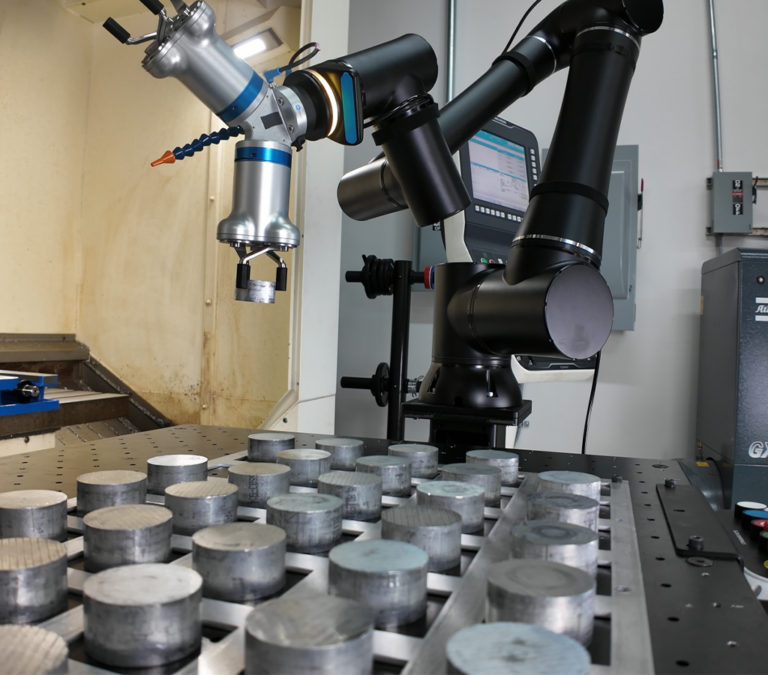
Machine Tending (CNC, Press, Injection Molding)
Industries: Metalworking, plastics, precision machining
Function: Loads/unloads parts, presses buttons, opens doors, and handles hot or sharp materials.
Benefits:
- Handles repetitive tasks efficiently
- Frees human operators for programming and setup
- Reduces workplace injuries and downtime
Example: A CNC shop added a cobot to its vertical mill on the second shift, adding six hours of extra runtime without hiring additional staff.
Pick-and-Place
Industries: Assembly lines, packaging, sorting, kitting
Function: Moves parts from bins to trays, trays to boxes, or conveyors to pallets.
Benefits:
- High repetition, low skill requirement
- Easy to train and reconfigure
Example: An electronics assembly line used two cobots to transfer circuit boards between stations, cutting transfer time by 30% and minimizing handling errors.
Palletizing
Industries: End-of-line operations across multiple sectors
Function: Stacks boxes or packages on pallets consistently and accurately.
Benefits:
- Reduces physically demanding work for humans
- Maintains continuous production
Example: A food manufacturer replaced a second-shift palletizing role with a cobot, saving $70,000 per year in labor costs while reducing injuries.
Assembly Tasks
Industries: Automotive, electronics, consumer products
Function: Fastens screws, presses parts, applies adhesives, or inserts small components.
Benefits:
- Consistent torque and placement
- Reduces fatigue and variability
- Improves product quality
Example: A consumer goods plant used a cobot for final assembly on a packaging line, reducing scrap by 22% and improving cycle time by 14%.
Welding Prep or Spot Welding
Industries: Sheet metal, industrial fabrication, automotive
Function: Tack welds, seam prep, and consistent weld paths.
Benefits:
- Maintains weld quality and consistency
- Frees skilled welders for complex tasks
- Reduces material waste
Example: A fabrication shop used a cobot to prep weld joints, tripling MIG welder productivity.
Inspection / Quality Control
Industries: Electronics, medical, automotive, food
Function: Vision systems detect defects, confirm alignment, or verify completeness.
Benefits:
- Reduces eye strain for human inspectors
- Detects micro-defects that humans might miss
- Tracks and documents every inspection
Example: A packaging facility added a vision-equipped cobot to check label alignment, cutting rework by 36% and saving 180 hours of manual inspection annually.
Common Characteristics of Cobot Tasks
Every cobot application shares these features:
- Repetitive and predictable processes
- Difficult to staff consistently
- Physically or mentally taxing for humans
- Measurable ROI in efficiency and safety
These applications are not just for large-scale, high-tech factories—they fit everyday manufacturing operations.
A Day in the Life of a Cobot
Consider an 8-hour shift with a cobot running a packaging line:
- Start: Operator loads initial supplies
- First 4 hours: Cobot packs bags into boxes every 8 seconds
- Break: Cobots continue while human operators rest
- Second 4 hours: Consistent performance without fatigue
- End: Operator unloads pallets and resets the line
Results: Over 2,000 cycles per day with perfect repeatability, allowing operators to manage multiple lines simultaneously.
ROI of Cobots in Manufacturing
Typical benefits include:
- Payback within 12 months
- Labor savings of $50K–$80K per cobot per year
- Reduced scrap and injuries, improved morale
- Increased uptime, especially on second shifts or weekends
Cobots are redeployable—today they may palletize, tomorrow they could handle assembly or inspection tasks.
Ready to See What a Cobot Could Do in Your Facility?
If you’re curious whether a cobot could help your team, CB Pacific can:
- Walk your floor virtually or in person
- Identify high-impact use cases
- Build a practical deployment plan
Start discovering how one cobot can transform your operations today.
Learn more: Collaborative Robots